ENGLISH CORNER, CON LINDA JIMÉNEZ – This week’s trivia question: There were four different groups incarcerated in the camps: Issei, Nisei, Sansei and Kibei. What do these terms mean?
During World War II the United States government forcibly relocated and incarcerated people of Japanese descent in concentration camps operated by the War Relocation Authority, mostly in the western interior of the country. These actions were initiated by an Executive Order that was issued by President Franklin D. Roosevelt in February 1942, following Japan’s attack on Pearl Harbor on December 7, 1941. The order affected everyone with “one drop of Japanese blood” living on the West Coast. The first of these camps was Manzanar, near Death Valley in eastern California. While most of the internees were Japanese, or Japanese American, there were also some mixed families. Elaine Buchman Yoneda was the daughter of Russian Jewish immigrants, married to Karl Yoneda, a Japanese American. She chose to follow him to the Manzanar camp in order not to be separated from their two-year-old son, who was about to be sent there alone.
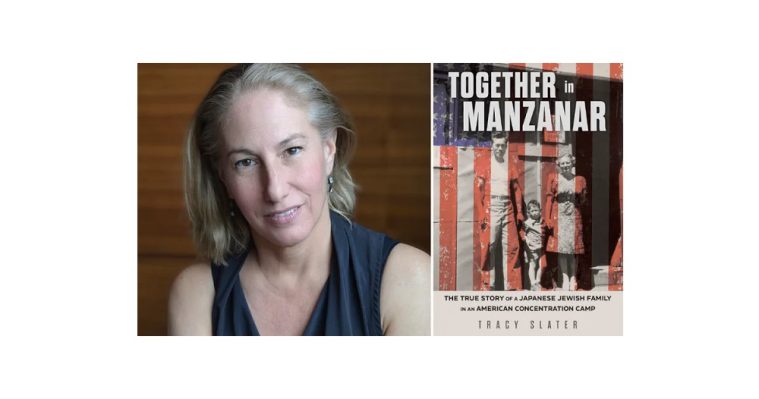
The incarcerated people were by no means a homogeneous group, and Together in Manzanar tells the story of the Yoneda family’s life in the camp in vivid detail, including the conflicts that arose among the internees as well as descriptions of daily life.
While the book is very well researched, and has copious endnotes, it is written in a very entertaining, easy to read style, and the last chapter tells us what became of the characters, like in a movie. This week we are speaking with Tracy Slater, the author of Together in Manzanar.
You can learn more about Japanese American incarceration during World War II here.